
Real vs Artificial Christmas Tree: Cost, Carbon and Hassle Compared
When comparing real vs artificial Christmas trees, environmental impact, cost and convenience are all worth considering. A 2m real Christmas tree has an estimated carbon footprint of around 3.5kg CO₂ when properly recycled, while a similar-sized artificial tree can have a footprint of approximately 40kg CO₂. Based on these figures, an artificial tree may need around 10 years of use to offset its higher initial carbon footprint. However, artificial trees can still be a practical choice if you plan to reuse them for many years or if someone in your household is sensitive to real Christmas trees.
Both options have their advantages, from the natural appearance and fragrance of a real tree to the convenience of storing and reusing an artificial one. Understanding these differences can help you choose the right Christmas tree for your home.
Our real Christmas tree delivery in London service makes getting a fresh tree easier, with delivery directly to your door.
Book your tree online if you've decided on a real Christmas tree.
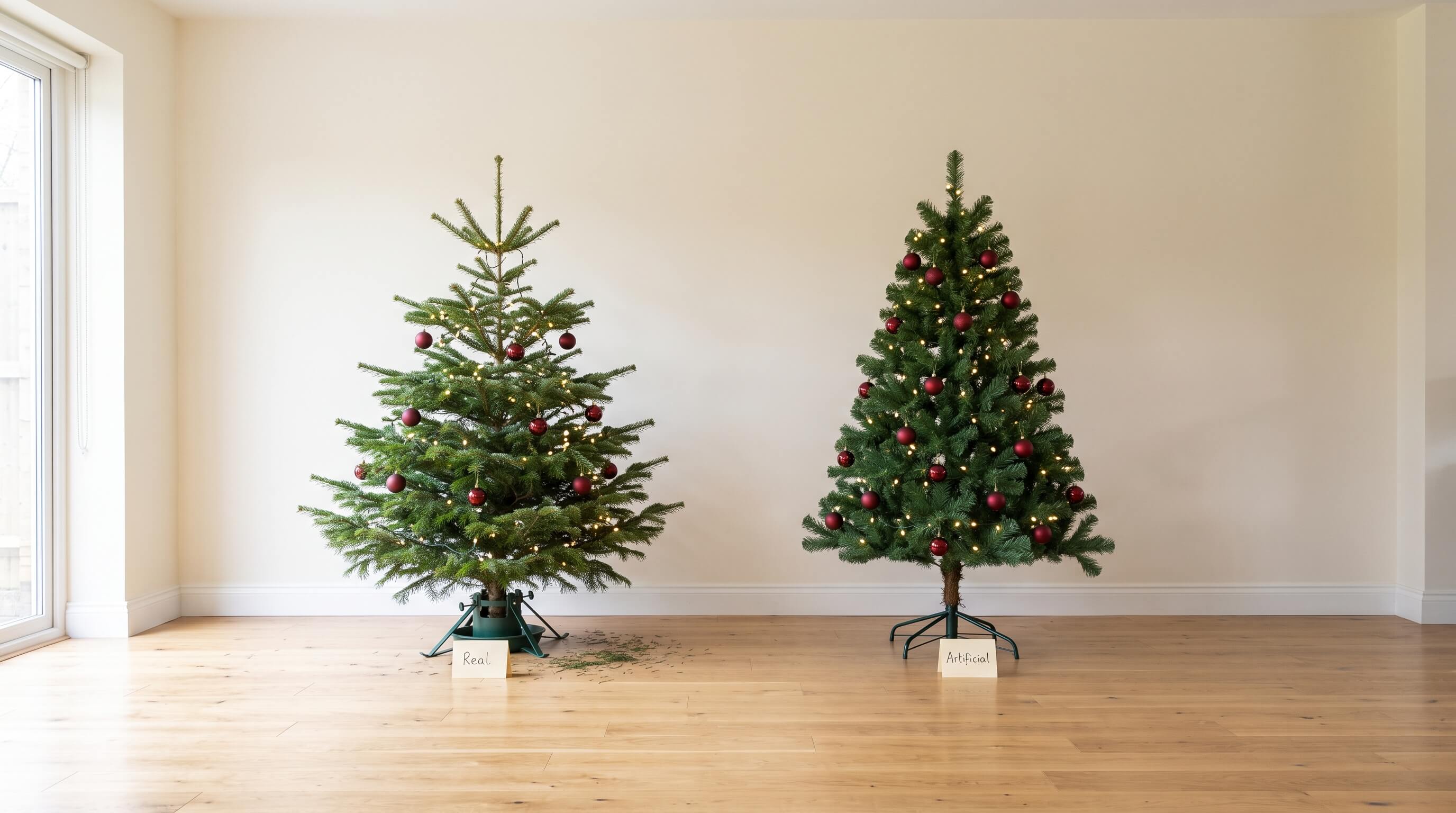
Real vs fake Christmas tree: the carbon numbers
The carbon footprint figures below compare Christmas trees of the same height, 2m (about 6.5 ft), taking into account their production and disposal.
| 2m tree | Approximate carbon footprint |
|---|---|
| Real tree, no roots, sent to landfill | 16kg CO2 |
| Real tree, chipped, burned or planted | 3.5kg CO2 |
| Artificial plastic tree | 40kg CO2 |
Two things stand out. First, most of an artificial tree's carbon footprint comes from its materials and production, with around two-thirds attributed to plastic and approximately a quarter to manufacturing. Second, a real tree sent to landfill has more than four times the carbon footprint of one that's chipped, so how you dispose of your Christmas tree makes a significant difference.
How many years of reuse an artificial tree needs
An artificial Christmas tree generally needs around 10 to 20 years of reuse to offset its higher initial carbon footprint compared with buying and recycling a real tree each Christmas.
If you already own an artificial tree, continuing to use it for as long as possible is a sensible way to reduce waste. If you're buying a new tree and expect to replace it within a few years, a real Christmas tree that's properly recycled is generally the lower-carbon option.
Are real Christmas trees better for the environment?
Real Christmas trees can have a lower carbon footprint than artificial alternatives, particularly when they're recycled rather than sent to landfill. However, there are other environmental factors worth considering.
Christmas trees take years to grow, with a typical 6–7 ft tree reaching its height after approximately 10–12 years. Christmas tree farms also plant new trees as part of their growing cycle. Almost 5 million real Christmas trees were obtained in the UK for Christmas 2023.
A pot-grown tree can be planted outdoors after Christmas instead of being chipped. However, the carbon footprint figures above are based on 2m trees, while our premium pot-grown Nordmann firs are smaller, at 2–3 or 3–4 ft. Living Christmas trees should also stay indoors for no longer than 12 days to reduce stress on the tree. If you prefer keeping your decorations up throughout December, a fresh-cut tree that's recycled afterwards may be the more practical choice.
Cost: what you pay and when
The main difference in cost comes down to whether you're making a one-time purchase or buying a new tree each year.
An artificial Christmas tree is a one-off expense that can be spread over several years. A real Christmas tree is an annual purchase, with prices varying by species, size and type. Norway spruce is generally among the more affordable real Christmas trees, while Nordmann fir tends to cost more. Pot-grown trees are usually the most expensive option.
With a real tree, you're also paying for a fresh, natural Christmas tree each year, without needing to find storage space for it once the festive season ends.
Another cost to consider is disposal in January. An artificial tree can simply be packed away, while a real Christmas tree needs to be recycled or disposed of responsibly. You can use your local council's collection service, visit a designated recycling point or arrange a collection from your home. If you need to drive to a recycling centre, the cost and environmental impact of that journey are also worth considering.
Hassle and storage in a London home
For many London households, available space and convenience can be just as important as price or environmental impact.
The artificial tree's hidden cost: space
An artificial Christmas tree needs somewhere to be stored for most of the year. In a London flat without a loft or spare cupboard, a large storage box can take up valuable space. Artificial trees can also collect dust and mould while stored, so it's worth cleaning the tree and decorations before putting them up each December.
The real tree's hassle: getting it in and out
A real Christmas tree comes with a few practical tasks. It needs to be transported home, secured in a suitable stand, watered daily and disposed of after Christmas.
Even varieties known for excellent needle retention will eventually shed some needles. A fresh-cut tree should also be kept away from fires, radiators and other heat sources to prevent it from drying out too quickly. With regular watering and proper care, it can last around four weeks, making it suitable for decorating from early December through Christmas.
Our Hassle-Free Christmas Tree service makes the process easier. Every tree we deliver is a Nordmann fir, available fresh-cut or premium pot-grown, with delivery included in the price.
For fresh-cut trees, our optional stand and installation package takes care of setting up the tree. You can also book Christmas tree collection and recycling across London, available from 2 to 31 January for any real Christmas tree. The team carries it out, sweeps up the needles and takes it to a licensed green-waste centre, where it's recycled into mulch.
Businesses may have different requirements, and our guide to choosing a tree for your office covers everything from selecting the right size to arranging installation and January collection.
When an artificial tree is the better choice
Artificial Christmas trees have several advantages, particularly for households looking for a long-term option.
- Allergies. Real Christmas trees can carry mould spores, pollen, dust mites and other potential allergens. Their natural scent may also trigger symptoms in sensitive individuals. An artificial tree that's cleaned before use may be a more comfortable alternative.
- You'll keep it for 10 to 20 years. Reusing the same artificial Christmas tree over many festive seasons helps spread its initial environmental impact over a longer period.
- You already own one. Continuing to use an existing artificial tree avoids the environmental impact of manufacturing and purchasing a replacement.
If you prefer a real Christmas tree but someone in your household has allergies, there are ways to reduce exposure. Choose a freshly delivered tree, shake or hose it down before bringing it inside, and consider wearing gloves and long sleeves when decorating. If symptoms persist or become severe, seek medical advice.
What happens to a real tree in January
Recycling plays an important role in reducing the environmental impact of a real Christmas tree. Across London, collected trees can be processed into wood chippings or compost, which may then be used to improve soil in parks and other green spaces.
Most council recycling services accept real Christmas trees once all decorations, tinsel, netting, stands, pots and soil have been removed. Some boroughs may also require larger trees to be cut into smaller sections before collection.
Avoid leaving your tree on the pavement unless it's part of an authorised collection arrangement. Improper disposal can be treated as fly-tipping and may result in a fine.
Christmas tree recycling services are particularly busy during the first week of January, with collection interest often peaking between 2 and 7 January. Planning ahead can help you avoid delays.
Collection arrangements and dates vary between London boroughs and may change each year, so check your local council's recycling information after Christmas.
The verdict
If you expect to replace an artificial Christmas tree within about 10 years, buying a real tree and recycling it afterwards will generally have a lower carbon footprint. Choosing delivery, installation and collection services can also make looking after a real tree much more convenient.
An artificial tree may be more suitable if you plan to reuse it for a decade or longer, already own one or need to avoid potential allergens associated with real Christmas trees.
FAQs
Is a real or fake Christmas tree better for the environment?
A 2m real Christmas tree that's chipped, burned or planted after Christmas has an estimated carbon footprint of around 3.5kg CO₂, compared with approximately 40kg CO₂ for a similar-sized artificial plastic tree. However, sending a real tree to landfill increases its estimated footprint to around 16kg CO₂. Proper disposal and recycling are therefore important factors in the environmental comparison.
How many years do you need to use an artificial tree?
An artificial Christmas tree generally needs around 10 to 20 years of reuse to offset its higher carbon footprint compared with buying and recycling a real tree each year. The exact period depends on the tree's materials, manufacturing process, transportation and how the real trees are disposed of.
Are artificial trees better for allergies?
Artificial Christmas trees may be more suitable for people who are sensitive to the mould spores, pollen or natural scents associated with real trees. However, artificial trees can also accumulate dust and mould during storage. Cleaning the tree and decorations before putting them up can help reduce exposure to potential allergens.
How do I get rid of a real Christmas tree in London?
Many London councils offer real Christmas tree collections or designated recycling drop-off points after Christmas. Collection dates and requirements vary, so check your local council's arrangements. You'll usually need to remove the stand, pot, netting and all decorations before recycling. Alternatively, you can book a Christmas tree collection service to have the tree removed directly from your home.
Book your tree online for a fresh-cut or premium pot-grown Nordmann fir. Stand and installation are available for fresh-cut trees, with January collection offered for both options.