
Nordmann Fir vs Norway Spruce vs Fraser Fir: Which Real Christmas Tree Should You Buy?
Of the three Christmas tree types in the UK compared here, Nordmann fir is a strong choice for a warm London flat, because its needles are very slow to fall. Norway spruce is the traditional, cheaper, better-smelling choice, but it drops its needles quickly. Fraser fir, which has good needle retention, a pine fragrance and a regular shape, is the third option you'll often see mentioned.
Every tree we deliver is a Nordmann fir, in two forms: fresh-cut in 5–6, 6–7 or 7–8 ft, and premium pot-grown in 2–3 or 3–4 ft. We don't sell Norway spruce or Fraser fir. They're in this guide as buying guidance, so you know how the three compare when you see them on sale.
Book your tree online if you already know a Nordmann suits you, and we'll bring it to your door across London.
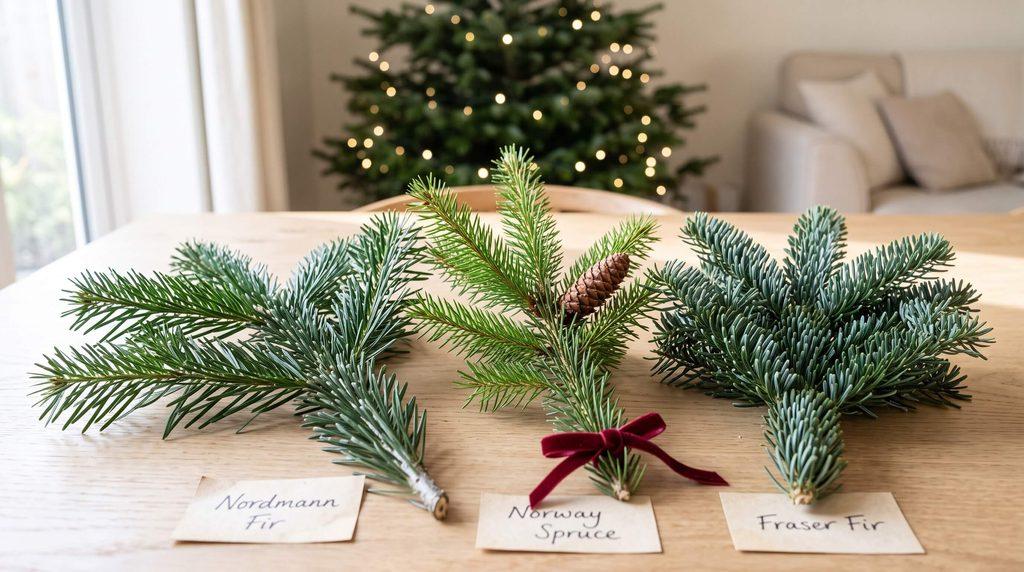
Christmas tree types in the UK at a glance
Here are the three species side by side:
| Feature | Nordmann fir | Norway spruce | Fraser fir |
|---|---|---|---|
| Latin name | Abies nordmanniana | Picea abies | Abies fraseri |
| Needle hold | Very slow to fall | Drops its needles quickly | Good needle retention |
| Look | Silvery bark; long, glossy, dark green needles with a white stripe underneath | Shorter, sharper, lighter green needles | Regular shape, similar to a Norway spruce |
| Scent | Not much scent | A pleasant, classic Christmas scent | Pine fragrance |
| Price band | One of the more expensive trees | One of the cheapest trees (as a cut tree) | Varies |
In short, if needle retention is your priority, a fir is the better choice. For a traditional Christmas tree fragrance, spruce stands out. If you're looking for a tree that can stay fresh in a centrally heated home throughout December, Nordmann fir is an excellent option thanks to its slow needle drop.
Nordmann fir: excellent needle retention
Nordmann fir (Abies nordmanniana) is one of the most popular Christmas trees in UK homes, accounting for around 75% of trees sold across the country.
Why people choose it
The main reason is its excellent needle retention. Nordmann fir has long, glossy, dark green needles with a distinctive white stripe underneath. The needles are slow to fall, helping the tree maintain its appearance from early December through to Boxing Day.
In a small flat, where the tree might sit next to the sofa or by the door, a tree that doesn't shed needles onto every surface makes a real difference.
The trade-offs
Nordmann fir has a much milder scent than other Christmas tree varieties. If you prefer a strong, traditional pine fragrance throughout your home, Norway spruce may be a better choice. Nordmann fir also tends to cost more than Norway spruce.
Like any Christmas tree, it takes years to grow. A typical 6–7 ft tree takes around 10–12 years to reach its full height.
Fresh-cut Nordmann fir from us
Our fresh-cut Nordmann fir comes in 5–6, 6–7 or 7–8 ft, with delivery included in the price. If you add our Nordmann fir delivery and set-up package (stand and installation), the team trims a small section off the base to expose fresh wood, sets the tree securely in a water-reservoir stand and tidies up any fallen needles. January collection can be added as well.
Premium pot-grown Nordmann fir from us
If you'd rather have a living tree, we also deliver premium pot-grown Nordmann fir in 2–3 or 3–4 ft. Our pot-grown Christmas tree delivery brings the tree to your door in its pot, and collection can be booked. There's no stand or installation with a pot-grown tree, because it stays in its pot.
A living Christmas tree needs a little extra care. Keep it in a cool room and bring it indoors as close to Christmas as possible, ideally the weekend before. Avoid keeping it inside for longer than 12 days. After Christmas, you can plant it in the garden or keep it in a container on a balcony or patio. However, bear in mind that Christmas trees can reach 15–20m in height after 20 years once planted outdoors, so you'll need to consider the available space, particularly in a small London garden.
When it comes to price, potted Christmas trees tend to be more expensive than fresh-cut varieties, making them a better choice for those who value the option of keeping their tree alive beyond the festive season rather than looking for the lowest price.
Norway spruce: the traditional choice
Norway spruce (Picea abies) is what many people picture when they think of a traditional Christmas tree. Known for its distinctive festive fragrance, it brings the familiar scent of a real Christmas tree into the home. If fragrance is your top priority, Norway spruce is an excellent choice.
The catch
Norway spruce tends to shed its needles quickly, particularly in centrally heated rooms. Its needles are shorter, sharper and lighter green than those of a Nordmann fir. As a fresh-cut tree, it requires more frequent cleaning around the base and may lose its appearance sooner than other varieties.
On the plus side, Norway spruce is generally one of the more affordable real Christmas tree options, making it a popular choice for those who prioritise traditional fragrance and value.
Fraser fir: fragrance and needle retention
Fraser fir (Abies fraseri) combines good needle retention with a pleasant pine fragrance and a naturally regular shape. It's a popular alternative for those who want a Christmas tree that looks attractive throughout the festive season while bringing a fresh, woodland scent into their home.
Fraser fir vs Nordmann fir
Both varieties retain their needles well, making them suitable for indoor Christmas displays. Nordmann fir is particularly well known for its slow needle drop, while Fraser fir offers good needle retention alongside a more noticeable pine fragrance.
Nordmann fir has a milder scent and long, soft, dark green needles, making it a practical choice for busy households. It's also the more widely available variety in the UK, accounting for approximately 75% of Christmas tree sales.
Which fir is the better choice?
If you prefer a noticeable pine fragrance alongside good needle retention, Fraser fir is worth considering. Nordmann fir is particularly suitable for warmer homes, offering excellent needle retention, soft foliage and a full, traditional Christmas tree appearance.
Nordmann fir vs Norway spruce in a centrally heated London flat
Many London homes are flats with radiators running all day and little spare floor space. Here's how the species compare in these conditions.
Heat and needle drop
Keep any cut Christmas tree away from fires and radiators, ideally in the coolest part of the room. In a flat, that might mean a corner of the living room rather than a spot next to the radiator. A cut Nordmann fir, with its very slow needle drop, is better suited to spending most of December indoors than a cut Norway spruce, which tends to shed its needles more quickly. A pot-grown Nordmann needs a shorter stay indoors, so bring it in close to Christmas and move it back outside within 12 days.
Space and height
Measure your ceiling height before choosing a Christmas tree. As a rough conversion, 5 ft is about 1.5m, 6 ft about 1.8m, 7 ft about 2.1m and 8 ft about 2.4m. Our fresh-cut sizes (5–6, 6–7 or 7–8 ft) are ideal for living rooms, while a 2–3 or 3–4 ft pot-grown Nordmann (about 0.6m to 1.2m) works well on a sideboard, in a narrow hallway or in a bedroom.
Pets
If you have a dog or cat, fallen needles can embed in paws, and pine oils can cause mouth pain, salivation, vomiting or diarrhoea. Even trees known for good needle retention will eventually shed some needles, so regular sweeping is important. With potted trees, fertiliser can be toxic to cats and may leak into watering trays. Some cats may also treat the soil as a litter tray.
Allergies
Mould spores and strong natural scents are among the allergy triggers associated with real Christmas trees. To reduce exposure, choose a freshly delivered tree and shake or hose it down before bringing it inside.
How to choose: a quick decision guide
- You want the tree up from early December. Choose a fresh-cut Nordmann fir. With proper care, a cut tree can last about four weeks, so a tree put up during the first weekend of December can stay looking fresh until Boxing Day. Our delivery season runs from 16 November to 23 December 2026.
- You want a living tree, and you have a balcony or garden. Choose a premium pot-grown Nordmann fir in 2–3 or 3–4 ft and bring it indoors close to Christmas.
- You need a small tree for a tight space. A pot-grown Nordmann is a practical option for smaller rooms, hallways or spaces where a full-size tree wouldn't fit.
- You prefer a strong, traditional Christmas tree fragrance. Norway spruce is a popular choice thanks to its distinctive festive scent, although it requires more care to manage needle drop.
- You want a balance of fragrance and needle retention. Fraser fir offers a pleasant pine scent and good needle retention, making it another option worth considering.
For a Christmas tree that stays looking fresh throughout the festive season, our fresh-cut Christmas tree delivery in London includes Nordmann fir in 5–6, 6–7 or 7–8 ft sizes, with a stand and installation available.
Looking after your Nordmann fir
A fresh-cut tree
Before placing your Christmas tree in its stand, saw approximately 2.5cm (1in) off the bottom of the trunk to help it absorb water. Use a stand with a water reservoir and check the water level daily. If the reservoir runs dry, the tree may begin losing its needles more quickly.
Until you're ready to bring the tree indoors, keep it in a cool, shaded outdoor spot with the trunk standing in water. Once inside, continue topping up the water every day to maintain freshness.
With our stand and installation package, the fresh cut and water-reservoir stand are taken care of for you. All you need to do is keep the water topped up.
A pot-grown tree
Keep your pot-grown Christmas tree in a cool room, water it regularly and avoid leaving it indoors for longer than 12 days. After Christmas, you can plant it in the garden or continue growing it in a container.
If keeping it in a pot, gradually move it into a larger container each year until the pot reaches approximately 45cm (18in) in width and depth. Use peat-free John Innes No. 2 compost and keep the tree well watered in a suitable outdoor spot until the following Christmas.
After Christmas
When it's time for the tree to go, our collection service runs from 2 to 31 January and can be booked with at least three days' notice. The team carries the tree out, sweeps up the needles and takes it to a licensed green-waste centre, where it's recycled into mulch.
FAQs
Which Christmas tree drops the fewest needles?
Of the three varieties, Nordmann fir is particularly well known for its excellent needle retention. Fraser fir also holds its needles well, while Norway spruce tends to shed them more quickly, especially in warm indoor conditions.
Do you sell Norway spruce or Fraser fir?
Our Christmas tree delivery service specialises in Nordmann fir, available fresh-cut in 5–6, 6–7 or 7–8 ft sizes and premium pot-grown in 2–3 or 3–4 ft sizes. Nordmann fir is a popular choice for London homes thanks to its excellent needle retention, soft foliage and full, traditional appearance.
Which real Christmas tree smells the strongest?
Norway spruce is known for its strong, traditional Christmas tree fragrance. Fraser fir also has a pleasant pine scent, while Nordmann fir has a much milder fragrance. If scent is your main priority, Norway spruce or Fraser fir may be more suitable.
What is the most popular Christmas tree in the UK?
Nordmann fir is the most popular Christmas tree variety in the UK, accounting for approximately 75% of Christmas trees sold. Its popularity comes from its excellent needle retention, attractive dark green foliage and suitability for indoor displays throughout the festive season.
Book your tree online to choose a fresh-cut or premium pot-grown Nordmann fir, delivered anywhere in London.